Dermal barrier & topical trials
What GHK-Cu skin research shows in human trials
A 2025 review confirms GHK's poor stratum-corneum permeability (clogP -2.24) as the central delivery challenge.
What does copper peptide do for skin in research?
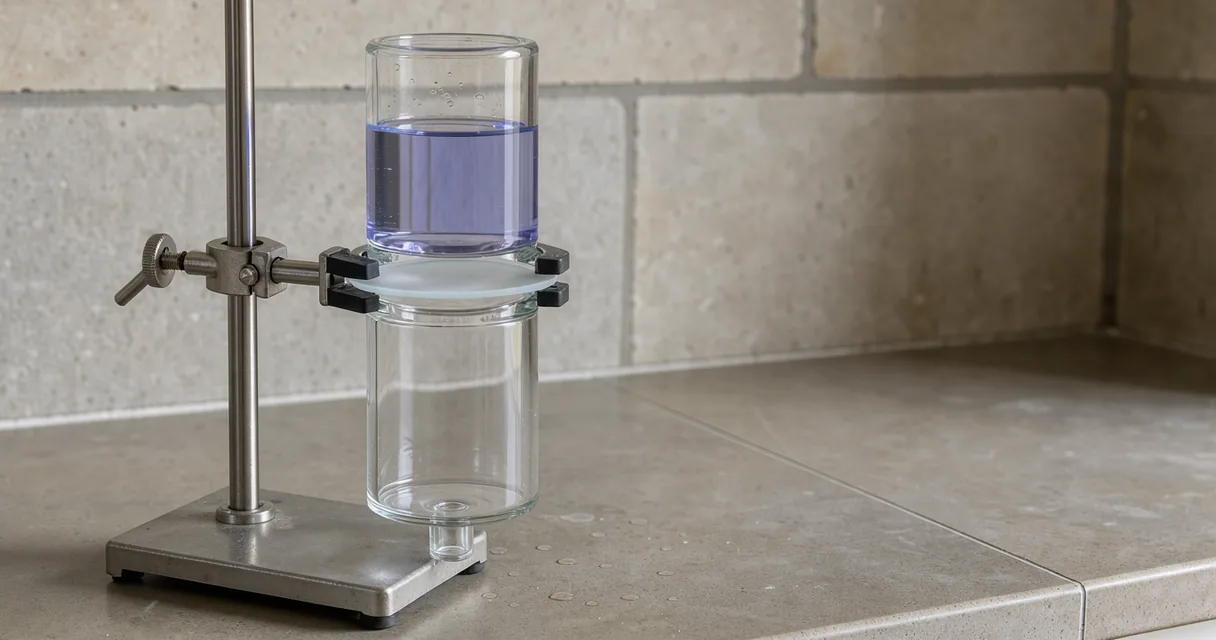
To measure copper permeation and retention across isolated skin layers, Hostynek, Dreher, and Maibach conducted a 2011 in vitro human skin penetration study using excised human skin mounted in diffusion cells for 48 hours. They reported that 136.2 +/- 17.5 micrograms per square centimeter of copper permeated through dermatomed skin over 48 hours (permeability coefficient 2.43 +/- 0.51 x 10^-4 centimeters per hour), while 97 +/- 6.6 micrograms of copper per square centimeter was retained in dermatomed skin over 48 hours.
A 2025 topical anti-wrinkle review by Mortazavi, Mohammadi Vadoud, and Moghimi summarized delivery challenges for hydrophilic GHK (clogP -2.24) and evaluated enhancement strategies including palmitoylation (Pal-GHK) and microneedle pretreatment, noting an experiment in which microneedle-pretreated skin allowed 134 nanomoles of GHK to permeate whereas untreated skin showed no passive permeation under those conditions.
Separately from the 2011 excised-skin experiment, in vitro fibroblast-culture studies — including the 1988 Maquart fibroblast study, the 2000 Simeon metalloproteinase paper, and the 2008 Pickart remodeling review — report that copper-bound GHK-Cu stimulates cultured fibroblasts to synthesize collagen and elastin while increasing matrix metalloproteinase-2 expression alongside tissue inhibitors TIMP-1 and TIMP-2.
Copper peptide vs retinol and vitamin C in skin trials
Readers sorting a skincare shelf often ask how Copper Tripeptide-1 compares with vitamin C and retinoic acid, a stronger relative in the retinol family. The 2015 Pickart, Vasquez-Soltero, and Margolina review reports the share of treated women showing increased collagen production across those three topical ingredients:
| Topical ingredient | Share of women with increased skin collagen | Typical skin tolerance & formulation notes |
|---|---|---|
| GHK-Cu cream (Copper Tripeptide-1) | 70% (Pickart et al. 2015) | Most stable near pH 5 to 6.5 in water as a 1:1 copper-peptide complex (Pickart 2008). |
| Vitamin C (ascorbic acid) | 50% (Pickart et al. 2015) | Low-pH ascorbic acid (below roughly pH 3.5) can reduce Cu(II) and disrupt the GHK-Cu complex (Mortazavi et al. 2025). |
| Retinoic acid (stronger retinol relative) | 40% (Pickart et al. 2015) | A stronger relative in the retinol family; retinol has been tested in far more people than GHK-Cu. |
I weigh my GHK-Cu cream expectations against the much larger clinical record for retinoids: retinol has been tested in far more people, whereas the GHK-Cu facial studies involved small cohorts and were summarized primarily by the discoverer's co-authors. In the 2006 laser resurfacing study of 13 patients, patient satisfaction was higher in the copper tripeptide group while objective erythema measurements showed no statistically significant difference versus control.
How GHK-Cu skin creams interact with acids
Even in a topical routine, formulation pH and pairing matter. The 2008 tissue remodeling review and the 2025 formulation review note that the 1:1 GHK-Cu complex is most stable near pH 5 to 6.5 in water, where Cu(II) d-orbital absorption gives intact preparations a blue-violet tint. Strong reducing agents such as low-pH L-ascorbic acid (below roughly pH 3.5) can reduce Cu(II) and disrupt the complex, while alpha- or beta-hydroxy acids and other low-pH actives can destabilize the complex or compete for copper, and brown or green color shifts indicate oxidation or precipitation. Staggering low-pH acids and copper peptides in a personal routine is common formulation and community troubleshooting rather than a tested clinical outcome on human skin. Check our FAQ page for quick answers on stability and color changes.