Chronological & model sequence · 1973–2025
Published GHK-Cu research studies in sequence
A decade-by-decade walk through the published literature, noting who wrote each study, which biological model they used, and where other laboratories confirmed or tempered early claims.
Early GHK-Cu research in blood and skin from 1973 to 2000
The GHK-Cu record begins in 1973 when Loren Pickart isolated a copper-binding tripeptide from human plasma that coaxed older liver tissue in culture to synthesize proteins like younger tissue, a history recounted in his 2008 tissue remodeling review. Fifteen years later, Maquart FX and Pickart published the 1988 human fibroblast culture study. In plastic culture wells, adding GHK-Cu stimulated collagen synthesis at picomolar concentrations (10 to the power of minus 12 to 10 to the minus 11 molar) and reached maximum output at 10 to the minus 9 molar without altering fibroblast cell numbers.
During the 1990s, tests branched into rodent models and analytical chemistry. A 1991 report on C3H mice showed that peptide-copper complexes stimulated hair follicle activity and growth in C3H mice. Then in a 1997 liquid chromatography study, Endo, Miyagi, and Ujiie injected GHK into rats and tracked its disappearance in plasma, establishing detection limits of 50 nanograms per milliliter for intact GHK and 15 nanograms per milliliter for its broken dipeptide product histidyl-lysine.
In the year 2000 Simeon, Emonard, Hornebeck, and Maquart published a crucial fibroblast metalloproteinase study demonstrating that GHK-Cu raises matrix metalloproteinase-2 mRNA and protein alongside TIMP-1 and TIMP-2 while copper-free GHK leaves MMP-2 unchanged. I anchor my GHK-Cu mechanism assessment to Simeon's MMP-2 experiment because it proves that copper-bound GHK-Cu and bare GHK act differently in fibroblast cultures.
Human skin trials and GHK-Cu studies from 2005 to 2016
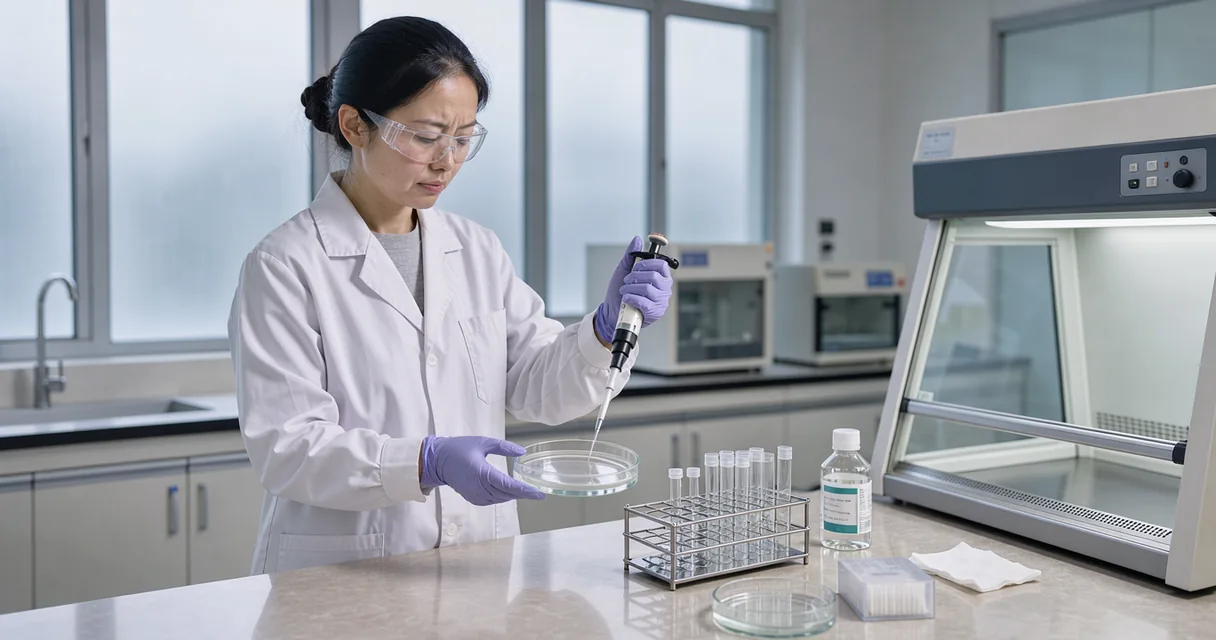
Between 2005 and 2016 researchers tested GHK-Cu across rat wound matrices, excised human skin, cultured donor lung fibroblasts, and small human topical trials. In a 2005 rat biomaterial study, Arul, Kartha, and Jayakumar reported that a biotinylated-GHK-incorporated collagenous matrix accelerated dermal wound healing in rats. One year later came the 2006 facial laser resurfacing trial in 13 human patients, where patient satisfaction was higher in the topical copper tripeptide group than in the control group, with no statistically significant objective difference in erythema.
In an excised-skin experiment, Hostynek, Dreher, and Maibach ran a 2011 in vitro skin diffusion study using isolated dermatomed human skin layers over 48 hours. They recorded 97 +/- 6.6 micrograms of copper per square centimeter retained in the dermatomed skin over 48 hours alongside measurable copper permeation across the isolated skin layers.
In the year 2012 Campbell and colleagues published an important emphysema lung fibroblast paper in Genome Medicine. Working outside Pickart's group, they showed through bioinformatic analysis and cultured chronic obstructive pulmonary disease lung fibroblasts that 10 nanomolar GHK reversed an emphysema-related gene-expression signature and restored TGF-beta-induced patterns, integrin beta-1 expression, actin cytoskeleton organization, and collagen-I gel contraction in the cultured COPD lung fibroblasts. Meanwhile, Pickart's 2012 oxidative stress review and 2015 skin regeneration review summarized biochemical and topical skin findings, followed by Lee and colleagues' 2016 six-month hair growth trial in 45 men.
Recent GHK-Cu animal studies and gene data from 2017 to 2025
The most recent decade of GHK-Cu research split into three tracks: rodent behavioral experiments, Connectivity Map gene profiles, and aging and fibroblast studies. Bobyntsev and colleagues reported 2015 rat anxiety data and Sever'yanova and Dolgintsev followed with 2017 rat pain-induced aggression tests after intraperitoneal injections of bare Gly-His-Lys.
In the year 2018 Pickart and Margolina published their widely cited Connectivity Map gene expression paper, reporting that GHK altered approximately 31.2% of human genes at a change threshold of at least 50%, with about 2,100 genes meeting that threshold (59% up and 41% down, plus 41 ubiquitin-proteasome system genes up and 1 down). I temper my GHK-Cu gene-expression expectations here: the approximately 4,000 gene figure is an extrapolation from the Connectivity Map analysis rather than a clinical trial.
Aging-focused studies from Ladiges W and colleagues appeared first in a 2020 anti-aging peptide review describing spatial learning and histone deacetylase 2 changes in aged mice given 10 to 15 milligrams per kilogram, and then in a 2024 in vitro study of cultured fibroblasts from aged mice showing reduced senescence markers p21 and p53, restored stemness markers p63 and PCNA, and enhanced dose-dependent migration and collagen-gel contraction, with integrin-beta1 signaling proposed as a pathway. Most recently, a 2025 melanogenesis culture study tested palmitoyl-GHK-Cu with acetyl tyrosine in A375 and B16 cells, and a 2025 topical delivery review described poor passive stratum-corneum permeability for hydrophilic GHK and evaluated palmitoylation and microneedle pretreatment as delivery-enhancement strategies. See our upsides and downsides page for what these findings mean in practice.