Printed bulletin · Nineteen sourced papers
Sorting GHK-Cu by the strength of each test
Putting fifty years of copper-peptide papers into strict experimental order — separating small human cream trials from excised skin chambers, rodent injections, and software gene tallies.
Human GHK-Cu trials versus animal studies
In a 2017 rat behavioral study on pain-induced aggressive-defensive behavior, Sever'yanova and Dolgintsev administered intraperitoneal injections of the free tripeptide Gly-His-Lys to rats and observed reduced pain-induced aggressive-defensive behavior and lower attack frequency in a rodent behavioral model. Notice two experimental details in that single paper: the subjects were laboratory rats receiving intraperitoneal injections, and the molecule tested was the bare Gly-His-Lys tripeptide without a coordinated copper ion. I withhold my GHK-Cu endorsement when a summary treats rodent behavioral injections as evidence for human skin care.
Other rodent experiments in the nineteen-paper GHK-Cu bibliography test different routes and chemical forms. In a 1997 rat plasma chromatography study, Endo, Miyagi, and Ujiie gave rats intravenous free GHK and showed that plasma peptidases rapidly cleave the tripeptide into the dipeptide L-histidyl-L-lysine, with high-performance liquid chromatography detection limits of 50 nanograms per milliliter for intact GHK and 15 nanograms per milliliter for histidyl-lysine. Separately, in a 2005 rat dermal wound study, Arul, Kartha, and Jayakumar applied a biotinylated-GHK-incorporated collagenous matrix as a topical tissue-engineering biomaterial and reported accelerated dermal wound healing in rats.
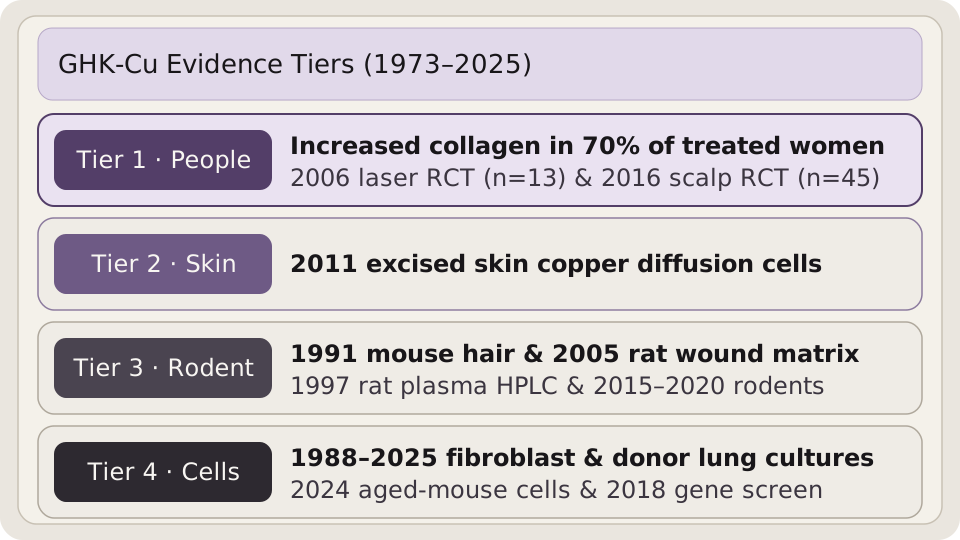
Placing those rat studies side by side shows why experimental model, route of administration, and peptide form determine what a finding can support. Living human evidence for GHK-Cu is restricted to small topical skin and scalp trials (Tier 1), followed by excised human skin permeation chambers (Tier 2), rodent models (Tier 3), and cultured cells or software gene screens (Tier 4). I reserve my GHK-Cu confidence for the small topical skin and scalp trials rather than rodent injections or cell-culture wells.
How GHK copper peptide works in skin and animal studies
Sorting by experimental tier clarifies what GHK copper peptide can and cannot claim. At the foundation sits Tier 4: cell cultures and software databases. In the classic 1988 fibroblast culture paper by Maquart and colleagues, human skin fibroblasts exposed to GHK-Cu increased collagen synthesis starting between 10 to the power of minus 12 and 10 to the minus 11 molar, peaking near 10 to the minus 9 molar without forcing cells to divide faster. Down on the same laboratory bench sits a biochemical rule established in a 2000 fibroblast study on matrix metalloproteinase-2: when investigators bathed fibroblast cultures in copper-bound GHK-Cu, the cells stimulated matrix metalloproteinase-2 expression and mRNA alongside tissue inhibitors TIMP-1 and TIMP-2, whereas free GHK peptide without its copper ion did not stimulate MMP-2. Without the divalent copper ion bound to the linear tripeptide, the molecule behaves differently in fibroblast wells. Thirty years after the 1988 collagen paper, a 2018 Connectivity Map analysis reported approximately 31.2% of human genes altered at a change threshold of at least 50%, with about 2,100 genes meeting that threshold (59% up and 41% down) and an extrapolated estimate of approximately 4,000 genes.
Tier 3 moves into living rodents, where blood enzymes and healing wounds enter the picture. In a 1991 mouse study, peptide-copper complexes stimulated hair follicle activity and growth in C3H mice, alongside the 2005 rat dermal wound study using a biotinylated-GHK-incorporated collagenous matrix and the 1997 rat plasma chromatography paper documenting rapid cleavage of intravenous GHK into histidyl-lysine.
Tier 2 tests excised human tissue on laboratory benches. In a 2011 skin permeation experiment, researchers clamped isolated human skin into diffusion chambers over 48 hours to measure how much copper actually crossed the outer barrier. And Tier 1 — living humans — consists exclusively of small topical studies on facial skin and scalp, reviewed across our research timeline and skin evidence page. In a randomized controlled 2006 laser resurfacing trial in 13 patients, clinicians applied a copper tripeptide cream after facial laser treatment: patient satisfaction was higher in the GHK-Cu group than in the control group, with no statistically significant objective difference in erythema between treatment and control. I take Miller's GHK-Cu laser trial as a realistic clinical baseline because higher patient satisfaction came alongside no statistically significant objective difference in erythema.
What is a copper peptide and what is Copper Tripeptide-1?
In plain structural terms, a copper peptide is a short chain of amino acids that grips a single copper ion. GHK stands for glycyl-L-histidyl-L-lysine, three amino acids linked in sequence. According to a 2008 tissue remodeling review, GHK binds divalent copper in a 1:1 ratio through nitrogen sites on glycine and histidine, forming a compact complex that turns pale blue-violet.
How Copper Tripeptide-1 is used on skin
On ingredient boxes for face serums and creams, regulatory naming conventions list the copper-bound molecule as Copper Tripeptide-1. A 2015 skin regeneration review notes that this topical cosmetic ingredient has appeared in commercial skin care for decades. Topical Copper Tripeptide-1 is a legal cosmetic ingredient, whereas GHK-Cu has no United States Food and Drug Administration-approved therapeutic indication to treat, cure, or prevent any disease.
Natural GHK blood data in young and older adults
Loren Pickart first isolated the tripeptide from human plasma in 1973. In his 2015 pathway review and an aging pathology review from 2020, authors report that human plasma around age 20 holds roughly 200 nanograms per milliliter of GHK (around 10 to the minus 7 molar), falling to roughly 80 nanograms per milliliter by age sixty. That age-related drop is an observational blood measurement rather than a diagnosed deficiency, and no human trial has tested whether injecting synthetic peptide restores youthful blood levels.
Comparing GHK-Cu benefits and study results by model
Comparing common claims against the published papers in our benefits breakdown and dosage analysis highlights four distinct verdicts:
| Public claim | Highest tier tested | What the cited paper actually measured |
|---|---|---|
| Wrinkle & skin collagen support | Tier 1 (Small human cream studies) | In a 2015 skin regeneration review, topical GHK-Cu increased collagen production in 70% of treated women, compared with 50% for vitamin C and 40% for retinoic acid. |
| Scalp hair count increase | Tier 1 (Blended complex in 45 men) | A 2016 six-month trial in 45 men found that a complex combining 5-aminolevulinic acid with GHK peptide (ALAVAX) increased hair counts by 71.5 hairs at 50 milligrams per milliliter and 52.6 hairs at 100 milligrams per milliliter versus 9.6 hairs with placebo. |
| Resetting 4,000 human genes | Tier 4 (Software database screen) | A 2018 Connectivity Map analysis reported approximately 31.2% of human genes altered at a change threshold of at least 50%, with about 2,100 genes meeting that threshold (59% up and 41% down); the approximately 4,000 figure is an extrapolation. |
| Subcutaneous injection protocols | Tier 3 (Rodents only) | Rat and mouse studies injected peptide into rodent bellies or veins; 1997 rat plasma testing showed rapid cleavage, and zero human injection trials exist. |
Anecdotal posts on peptide forums frequently describe self-mixed subcutaneous vials as if they carried the same evidence as a cosmetic cream. Sorting the papers by tier shows that every human datapoint comes from topical application. Check the FAQ for plain answers on stability and acid interactions.